

By steve anyebe.
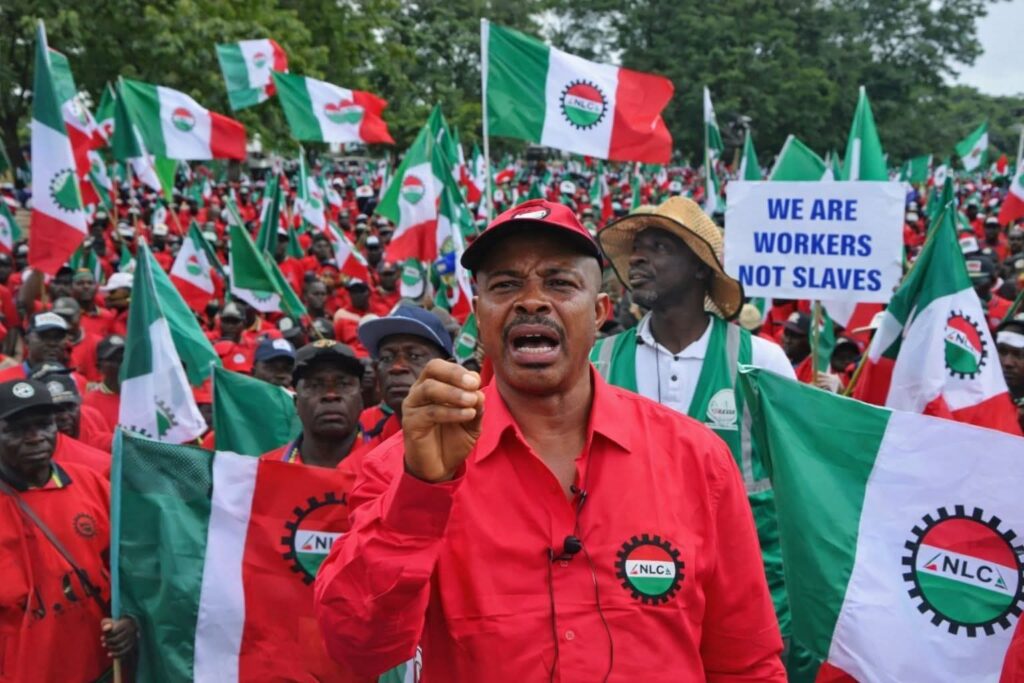
The apparent longstanding bellicose poise of employers towards workers, both in the public and private sectors, had since created a subsisting culture of hard-core protest unionism in Nigeria. With time, therefore, labour became unanimous with protests, workers strikes being the standard expression of grievance, after which Government would then invite labour leaders for talks. However, since Joe Ajaero became President of the Nigerian Labour Congress in 2023 there appears to have been a shift from the traditional protest culture to one of constructive engagement, where protest, though not discarded, now only serves as the very last resort after constructive engagements must have failed to resolve the constant issues regarding workers living conditions, which must expectedly rear their heads now and then. So far Ajaero’s new style has benefitted both workers and employers more in terms of labour relations. A few features of this strategy and its applications easily lead to this conclusion:
Fuel Subsidy Removal.
The removal of fuel subsidy, the first official pronouncement made by President Bola Ahmed Tinubu after he took his oath of office on 29th May 2023, was greeted with fury and condemnation across the land because it resulted in instantaneous hike in prices of virtually everything. Since then Nigeria has not been the same as living conditions of Nigerians, workers especially, have progressively deteriorated.
Comrade Joe Ajaero, President of the Nigerian Labour Congress, did not declare instant workers’ strike as was expected. Instead, he vented the workers’ displeasure after meeting with labour leaders and articulating the likely repercussions of the fuel subsidy removal. He then espoused the actions Government could embark upon immediately to insulate workers from the untold suffering brought upon them, while he also served notice of a general workers’ strike should their demands be ignored. Subsequently, Labour engaged Government in a novel strategic bargaining which resulted in wage support and social relief pronouncements to cushion the hard times. The baseline was that while the public was successfully fully mobilised for a showdown with Government, concessions were still extracted through meaningful dialogue. That was leadership sensitivity demonstrated by Comrade Joe Ajaero at a very critical point in national political discourse.
2024 Workers Wage Showdown.
The tone Comrade Ajaero set during the negotiations between Labour and Government, after the fuel subsidy removal, apparently continued into the face-off that developed in the 2024 negotiations to arrive at a new workers minimum wage. Unprecedented inflationary rates had engulfed Nigerian markets consequent upon the removal of fuel subsidy. This necessitated the demand of an ambitious minimum monthly living wage of 615 thousand naira for Nigerian workers. Joe Ajaero had a position that not even Government could differ from: that the greatest determinant of wages should be the prevailing economic realities at any given time.Delay from the side of Government, and what looked like deliberate attempts at scuttling negotiations, forced Labour to declare a strike at a stage. Again the NLC President prevailed on his colleagues to pause the strike to enable Government take a stand on Labour’s revised rate. Again Ajaero showed class with his new style in which Labour applied pressure with the strike; engaged Government in talks; paused for response; reassessed outcome; then decided next move (all the time actively and transparently carrying workers along).
2024 Wage Talks Breakdown Strike.
Anybody in Nigeria during the minimum wage negotiations in 2024 would not forget the effects of the general strike declared by all labour affiliates when there was a deadlock in the talks between Labour and Government representatives. The most hard hit sectors by the total lockdown of workers’ services were the power and aviation sectors. Power supply was completely cut off while all flights were grounded. The NLC President’s policy of strike only as the last resort had gained so much acceptance that the public heaped all blames on Government when the strike grounded the whole country. Labour was roundly commended all across the country as Ajaero seemed to demonstrate more maturity of purpose and concern for both national economic productivity and even workers’ welfare, both which used to be affected negatively by prolonged strikes.
Beyond Workers Welfare.
Any discerning mind in Nigeria since Comrade Joe Ajaero assumed duties as the helmsman at the NLC will, no doubt, have noticed a deliberate expansion of labour engagements over the usual horizon of the struggle for the betterment of workers welfare. Ajaero has obviously aligned with, not just workers, but the entire Nigerian populace as he has often used his position to demand general accountability from the incumbent administration; whenever he expresses concerns about the terrible effects of inflation and consequent eroding of the purchasing power of Nigerians; whenever he speaks out against electricity tariff increments; when he speaks on fuel pricing mechanisms; as well as his stand on the electoral act amendments.
This actions show a person positioned more as a nationalist than a mere labour leader. It is no wonder then that Labour has drawn much sympathy, acceptance, and collaboration from Civil Society Organizations and students bodies.
Media Engagements.
Joe Ajaero has deployed the media arm of the NLC in union engagements more than any past regime. While issuance of press statements dedicated to labour positions on national and international issues has continued, the Head of Information and Media of NLC has become the toast of both the public and media establishments with his incisive engagements and parleys on television and radio. This singular publicity and enlightenment strategy has placed labour very high in the public eye both in Nigeria and on the global stage. It also gives NLC the rare opportunity of monitoring and evaluating feedbacks, very essential ingredients in labour engagements and negotiations.
Lessons From Ajaero.
There are many lessons to be learnt from Comrade Joe Ajaero’s policy of shifting from protests to constructive engagements, one of which is the progressive democratic stand that resolution of conflicts through dialogue and negotiations is always better than confrontation, which should only be deployed as the very last resort only.
Ajaero has also proved that economic productivity must not be jettisoned on the table of unionism using prolonged strikes, which cause uncertainties and affect even workers’ welfare negatively.
The Ajaero model has led to the cultivation of higher public perception and respect for labour demands, making room for much greater understanding by even labour’s traditional adversary: Government.
As there are sure to be challenges ahead, Nigerians wait to see how the new labour formula would successfully deal with them.
For now Comrade Joe Ajaero has engendered a new labour culture inculcating unyielding defence of workers rights and a more secured future for labour unionism. And he has been able to do this through a combination of courage and critical thought deployment in a milieu where strategic negotiation gives higher meaning to street lock-downs.
steve anyebe can be reached at steveogwuanyebe.com and mustardpoint.com.
